Leg Hypertrophy Blueprint: Quadriceps, Hamstrings & Adductor Mechanics
Master lower body biomechanics for massive legs. Learn the science of deep knee flexion, seated vs lying leg curls, and adductor development.
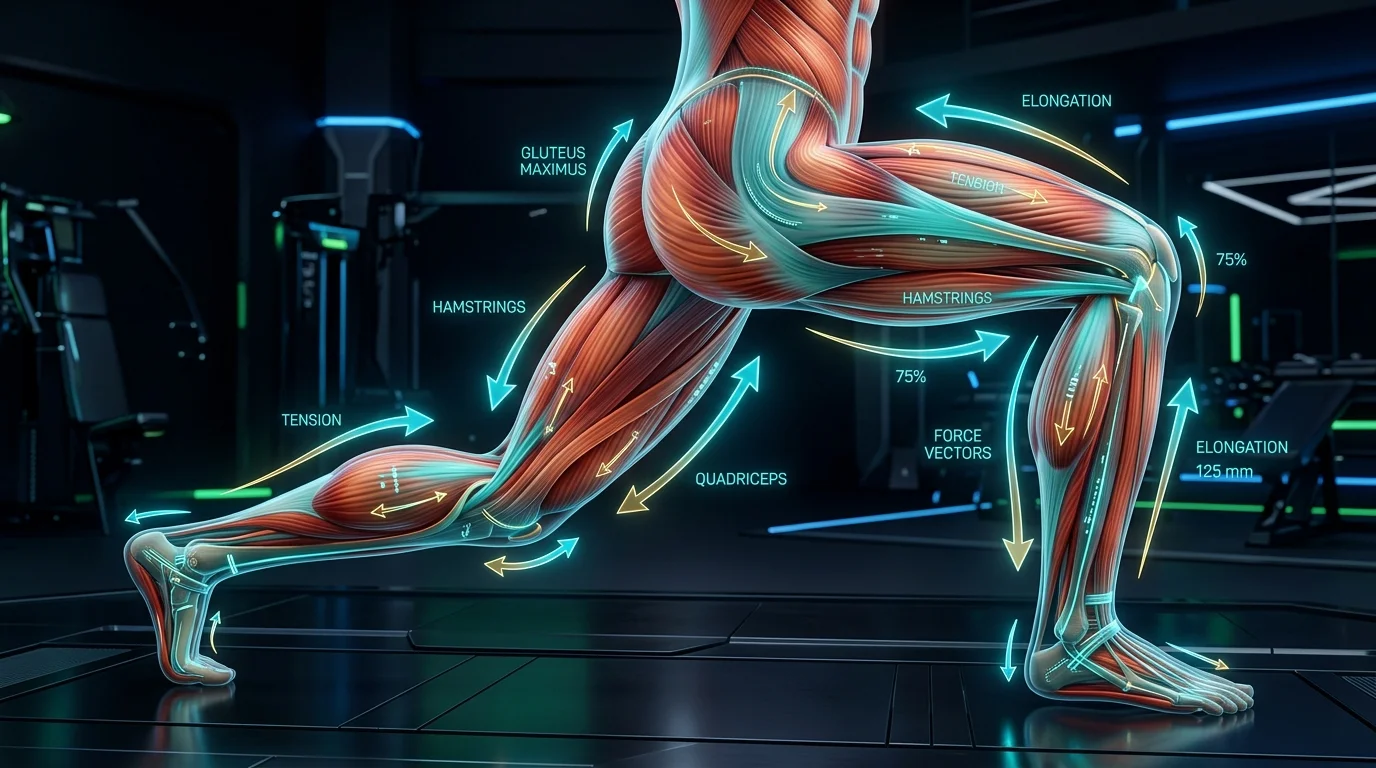 AI-generated
 Table of Contents
Why do so many lifters spend hours under heavy barbells yet end up with lagging quadriceps, shallow hamstrings, and chronic knee pain?
Lower body hypertrophy is notoriously demanding. Leg movements generate the highest levels of systemic and axial fatigue in resistance training. If your exercise selection and biomechanics are inefficient, you end up accumulating massive lower back fatigue while your target leg muscles remain under-stimulated.
In this blueprint, we break down the functional biomechanics of the lower body, explain why seated leg curls outperform lying leg curls, and show you how to structure quad, hamstring, and adductor volume for maximum leg growth.
Key Takeaways
- Deep Knee Flexion for Quads: Quadriceps growth (particularly the vastus lateralis, vastus medialis, and vastus intermedius) is directly proportional to the degree of knee flexion over the toes under load, not how far back you push your hips.
- Rectus Femoris Exception: The rectus femoris crosses both the hip and knee. In multi-joint squats and leg presses, it stays at a constant length and experiences minimal growth. Direct Leg Extensions or Sissy Squats are required to isolate the rectus femoris.
- Seated vs. Lying Leg Curls: Research proves that seated leg curls produce ~1.5x greater hamstring growth than lying leg curls because 90° of hip flexion stretches the biarticular hamstring heads at their origin.
- The Forgotten Giant (Adductor Magnus): The adductor magnus is one of the largest muscles in the lower body and is a primary hip extensor in deep squats. Adding direct adductor machine work dramatically increases inner thigh sweep and leg circumference.
Quadriceps Biomechanics: Knee Travel & Stability
┌────────────────────────────────────────────────────────┐
│             QUADRICEPS MUSCLE GROUP COMPOSITION        │
│                                                        │
│  [Vastus Lateralis]   ──► Outer Quad Sweep (Monoart.)  │
│  [Vastus Medialis]    ──► Teardrop Knee Stabilizer     │
│  [Vastus Intermedius] ──► Deep Central Quad Extensor   │
│  [Rectus Femoris]     ──► Biarticular (Crosses Hip)    │
└────────────────────────────────────────────────────────┘
To maximize tension on the vasti muscles during compound presses:
- Elevate Your Heels: Using Olympic lifting shoes or a 15° wedge reduces ankle mobility restrictions, allowing your knees to travel far over your toes while keeping your torso upright.
- Prioritize Stable Machines: Hack squats, pendulum squats, and heavy leg presses provide external spinal stability, allowing you to take the quadriceps to true 0–1 RIR without your lower back or core failing first.
Hamstrings Biomechanics: Hip Hinge vs. Knee Flexion
The hamstrings consist of the biceps femoris (long and short head), semitendinosus, and semimembranosus. Because the long head, semitendinosus, and semimembranosus originate on the ischial tuberosity (pelvis) and insert below the knee, they perform two separate actions:
1. Knee Flexion (Seated Leg Curl)
The seated leg curl puts the hamstrings in a position of combined hip flexion and deep knee extension at the start of each rep. This maximizes stretch-mediated hypertrophy across all hamstring heads.
2. Hip Extension (Romanian Deadlift)
The Romanian Deadlift (RDL) heavily overloads the hamstrings and glutes in the lengthened hip-hinge position. Keep knees slightly bent at ~15° and push hips straight back into the wall to maintain pure tension on the posterior chain.
Complete Lower Body Exercise Selection Matrix
| Muscle Area | Primary Compound Lift | Direct Isolation Movement |
|---|---|---|
| Vasti Quads (Outer/Teardrop) | Heel-Elevated Hack Squat | Leg Press (Low & Close Stance) |
| Rectus Femoris (Upper Quad) | — (Requires pure knee extension) | Seated Leg Extension (Lean Back) |
| Hamstrings (Lengthened) | Romanian Deadlift (Dumbbell/Barbell) | Seated Leg Curl (90° Hip Flexion) |
| Adductor Magnus (Inner Thigh) | Deep Squat (Below Parallel) | Seated Adductor Machine |
| Calves (Gastrocnemius) | — | Standing Straight-Leg Calf Raise |
How ELVT Automates Lower Body Programming
Leg workouts generate intense systemic fatigue. Managing weekly sets and avoiding overreaching requires precise tracking.
ELVT – Hypertrophy by Design takes the guesswork out of leg day:
- Quadriceps vs. Hamstrings Balance: ELVT tracks weekly volume distribution between anterior and posterior chain muscles, alerting you if your hamstrings are lagging behind your quad sets.
- Seamless Exercise Substitutions: If a hack squat or barbell squat irritates your knees or lower back, swap to a machine leg press with 1 tap during your active session while preserving set records.
- Free to Start & ELVT Pro for Everything: Start free with ads, or upgrade to ELVT Pro (7-day free trial) to unlock every feature ad-free—full analytics, in-session autoregulation, unilateral tracking, and the plate calculator.
[!TIP] Build bigger, more balanced legs without beating up your joints. Download ELVT for free on iOS and Android to plan your next lower body block.