Chest Hypertrophy Masterclass: Clavicular, Sternal & Costal Biomechanics
Master pectoral biomechanics for complete chest growth. Learn how arm path alignment, incline angles, and converging cables isolate every chest division.
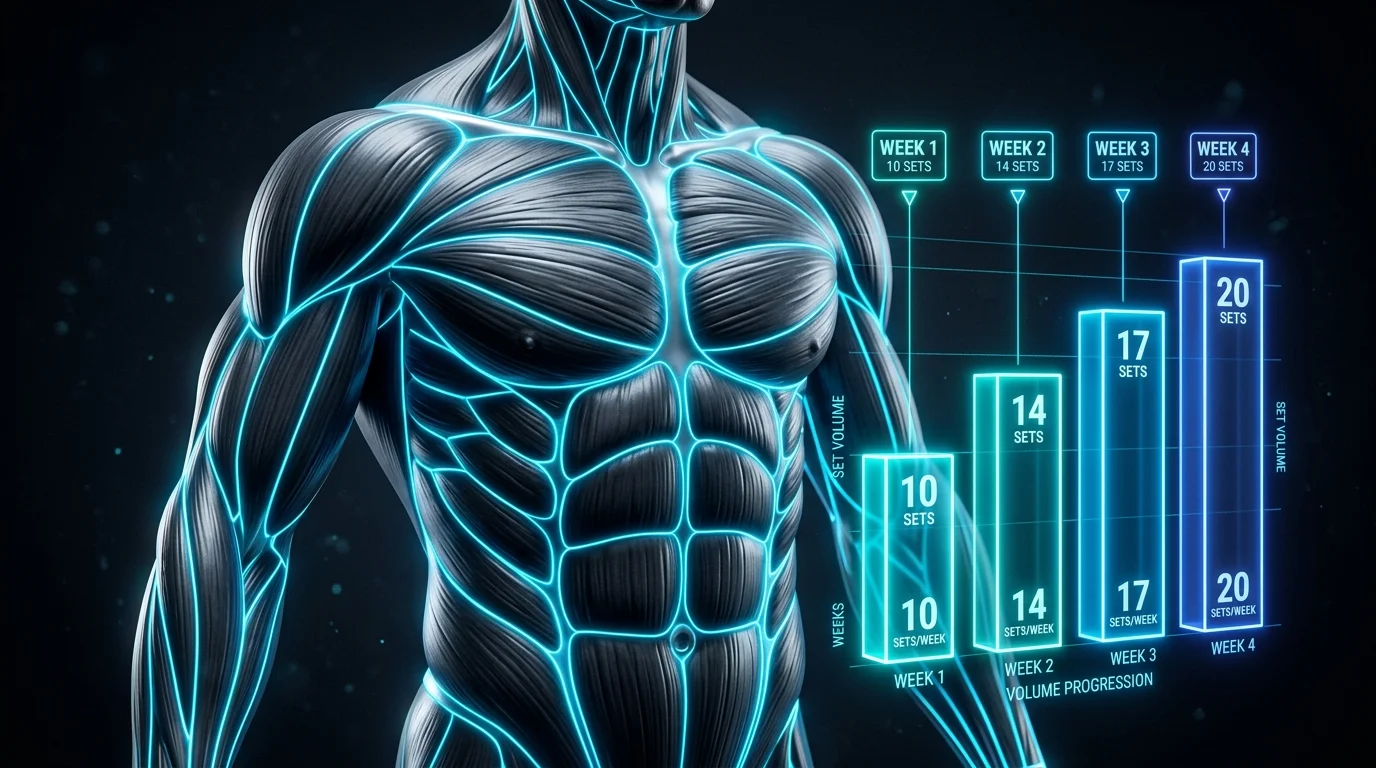 AI-generated
 Table of Contents
Why do so many lifters bench press for years yet still struggle with a flat upper chest and underdeveloped inner pectorals?
The pectoralis major is not a single, uniform slab of muscle. It consists of multiple distinct anatomical divisions, each with its own origin point and unique fiber orientation. To build complete, 3D chest development, your arm path must match the exact line of pull of the specific fibers you want to target.
In this masterclass, we break down the functional anatomy of the chest, analyze the biomechanics of pressing and flye variations, and show you how to program for total pectoral hypertrophy.
Key Takeaways
- Three Anatomical Divisions: The chest consists of the Clavicular Head (Upper), the Sternal Head (Mid), and the Costal Head (Lower).
- The Line of Pull Principle: Muscle fibers produce maximum force when the arm moves parallel to their anatomical orientation. For upper chest, press on a 15° to 30° incline; steeper 45°+ angles shift tension away from the pecs onto the anterior deltoids.
- Converging vs. Fixed Barbells: Fixed straight barbells limit horizontal adduction at the top of the movement; dumbbells and converging cables allow your hands to travel across the midline for superior contraction and stretch.
- Internal Rotation Setup: Retract and depress your scapulae, maintain a stable ribcage arch, and flare elbows to roughly 45° to 60° relative to your torso to protect the rotator cuff while keeping maximum tension on the pectorals.
Functional Anatomy of the Pectoralis Major
┌────────────────────────────────────────────────────────┐
│             PECTORALIS MAJOR FIBER ORIENTATION         │
│                                                        │
│  [Upper / Clavicular]   ──► Angled Downward & Outward  │
│  [Mid / Sternal]        ──► Running Horizontally       │
│  [Lower / Costal]       ──► Angled Upward & Outward    │
└────────────────────────────────────────────────────────┘
1. Clavicular Head (Upper Chest)
- Origin: Medial half of the clavicle (collarbone).
- Insertion: Lateral lip of the bicipital groove of the humerus.
- Primary Function: Shoulder flexion and horizontal adduction across the upper chest.
- Optimal Arm Path: Moving diagonally upward and inward (e.g. 15–30° Incline Dumbbell Press, Low-to-High Cable Flyes).
2. Sternal Head (Mid Chest)
- Origin: Sternum (breastbone).
- Primary Function: Pure horizontal adduction across the chest midline.
- Optimal Arm Path: Moving straight across the torso (e.g. Flat Dumbbell Press, Machine Chest Press).
3. Costal / Abdominal Head (Lower Chest)
- Origin: Ribs and aponeurosis of the external obliques.
- Primary Function: Shoulder extension and horizontal adduction moving downward.
- Optimal Arm Path: Moving diagonally downward (e.g. High-to-Low Cable Flyes, Chest Dips).
The 30° Incline Rule: Stop Setting Benches to 45°
One of the most common mistakes in commercial gyms is setting the incline bench to 45 degrees for “upper chest.”
EMG and force-vector studies show:
- At 15° to 30° incline, clavicular head activation peaks while anterior deltoid involvement remains moderate.
- At 45°+ incline, anterior deltoid recruitment surges by over 40%, robbing the upper pectorals of the primary mechanical tension.
Pro Tip: Keep your adjustable bench on the first or second notch (around 15° to 30°) for maximum upper pectoral stimulation.
Biomechanical Comparison of Staple Chest Exercises
| Exercise | Peak Tension Zone | Scapular Freedom | Primary Head Targeted |
|---|---|---|---|
| 30° Incline Dumbbell Press | Lengthened (Bottom Stretch) | High (Independent arms) | Clavicular (Upper) |
| Seated Converging Cable Press | Shortened & Lengthened | High (Continuous tension) | Clavicular & Sternal |
| Flat Barbell Bench Press | Mid-Range | Locked to bench | Sternal (Mid) |
| Chest Dips (Forward Lean) | Lengthened (Deep stretch) | High | Costal (Lower) & Sternal |
| Standing Cable Crossover | Shortened (Peak contraction) | High | Sternal & Costal |
How ELVT Optimizes Your Chest Training
Tracking your chest volume across workouts is essential for progressive overload.
ELVT – Hypertrophy by Design streamlines your training:
- Major Muscle Group Volume Tracking: ELVT tracks weekly volume sets for your major muscle groups, giving you clear visibility into your chest training load.
- Streamlined Workout Logging: Log your working sets, reps, and RIR seamlessly with intuitive notes to capture training context.
- Free to Start & ELVT Pro for Everything: Start free with ads, or upgrade to ELVT Pro (7-day free trial) to unlock every feature ad-free—full analytics, in-session autoregulation, unilateral tracking, and the plate calculator.
[!TIP] Build a fuller, thicker chest with biomechanically optimized training. Download ELVT for free on iOS and Android today.